Feeds:
Posts
Comments

My three horses, Kiona, Rainbow and Prince, just had their spring appointment with Veterinary Equine Dentist Dr. Richard Vetter, DVM. (His website is very informative, check it out!) About 10 years ago I learned something about the difference between a dental specialist versus a general practitioner vet doing dentistry (floating teeth). Ever since having my eyes opened to this contrast, I make it a point to have my horses see a dental specialist at least every two years, and generally every year (or more often if necessary). (In fact, before this week’s appointment it had been two years, and now I regret waiting that long. That is, they’ve been checked by other vets every six months, and even floated some, yet were still overdue for the level of care that a specialist can provide. I know this not only because of what Dr. Vetter could show me in their mouths, but also by Rainbow’s difficulty chewing recently, Kiona’s sores inside her cheeks, and the limited side-to-side range for chewing/grinding for all three horses).

For the “inbetween” appointments, in my case usually for the fall shots for example, or perhaps at a chiropractic appointment, I certainly appreciate any vet taking a look in their mouth to check on them. General practitioners are very capable of basic care, of course, but how can they be expected to do any more than this minimum without the time and training devoted to teeth as a specialty? Would you rely on your doctor to take care of your own teeth? Waiting for sharp points and sores on the inside of the cheeks to do some floating is like waiting for your horse to go lame before doing preventative care for their muscles and joints, like massage or chiropractic care.

Using massage as an analogy here is especially appropriate because of the close connection between a horse’s teeth and their musculoskeletal system. Problems with the teeth, whether pain issues or problems with the symmetry and range of motion for how the top and bottom teeth meet and move, can have very direct consequences for your horse’s ability to move correctly, athletically, and comfortably. Again, I invite you to check out Dr. Vetter’s website, because you’ll find lots of information there about these topics!

The latest from Horse Tip Daily Radio…
Horse Tip Daily #173 – Megan Ayrault on Listening with Your Hands:

Dr. Deb Bennett, Ph.D., author of several books including the wonderful series, Principles of Conformation Analysis, is also the founder of a great website, Equine Studies Institute. Check out especially the “Knowledge Base” area of the site. As described there, “This section of the ESI Website is intended to grow as readings are added yearly. The central theme is the “natural history” of rider and horse. This takes in anatomy and biomechanics (both human and equine), zoogeography, evolutionary history, and developmental biology.”

I had the opportunity to take an anatomy class from Dr. Deb several years ago, and to say she’s a wealth of knowledge is a gross understatement!

We’re lucky to have right here in Western Washington a state of the art equine rehabilitation facility called Pegasus. Technology and services include not only swim therapy and an underwater treadmill, but even hyperbaric oxygen therapy, whole body vibration therapy, solarium, and more. You can find a video tour on the website, which is beautiful to watch, but having been on a tour myself, the video doesn’t remotely do justice to the services offered, and the difference they make for injured horses. (Though if you watch long enough, you will see a horse in the pool, and one entering and exiting the hyperbaric chamber.)

Another video….

Here’s another video, this time one of mine. I’ll be working this year on getting more short videos produced to share more techniques and tips, so stay tuned!

Nice video overview

So I came across this nicely edited video I thought you’d like, giving a wonderful overview of horse massage, and a little of what it’s like to be an equine massage therapist. Then I realized, hey, I know that woman! In the video, she doesn’t have the red hair I remember from when we’ve taken a couple of classes together a few years back, but I’m very happy to see her again via youtube at least 🙂  and to share her beautifully done video with you here. Thank you, Rebecca Thomas, for your great work!

Gastric ulcers

Here’s a link to a wonderful new blog from Horse Haven at Bear Creek, and specifically to Robyn’s post about gastric ulcers. As so often happens, we learn about health the hard way, through the lack of it, or dis-ease in some form. May Lily’s experience help others learn this lesson sooner and with greater ease….

You’ll also see that I’ve also added a comment at the bottom of Robyn’s blog post, relating the topic to bodywork and massage.

Animal Massage Myth #9: “You must have to be really strong to massage a horse!”

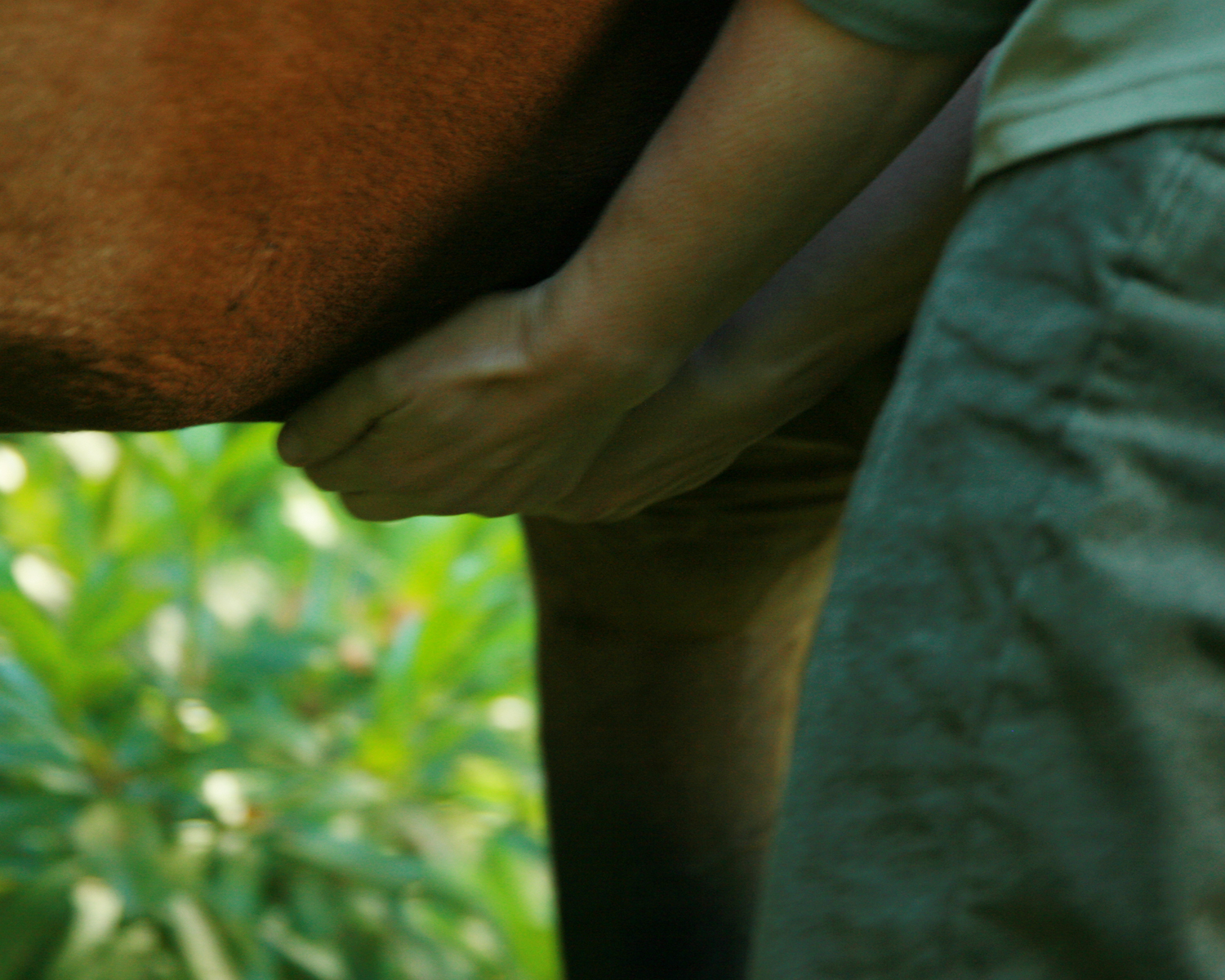
This is one of the most frequent comments I hear when I tell someone what I do for a living. The fact is, although being fit is helpful for certain techniques and styles of bodywork (and necessary for some), it’s really not about strength. Even a small child can offer great benefits to the largest of horses with the right techniques, focus and intention. What people generally don’t think about, even in relation to themselves let alone their animals, is that the body has great intelligence and is designed to re-balance itself in any number of ways. This intelligence and ability can very easily (and often does) get off track, stuck or even distorted, but the potential is still there, ready and waiting for the right conditions and reminders to trigger it. Most of what happens during massage and bodywork is happening inside the body, connected to but not actually coming from the hands of the therapist. Sometimes your hands don’t even seem to be doing anything at all, and yet the animal is clearly processing and focusing internally, and getting wonderful relaxation and other benefits.

The fact that your hands are on your animal (or even just nearby in some cases), and also very importantly that your mind is focused on helping and loving your animal, can be all that’s needed to create positive effects. With more training and experience, you can also get much more efficient and deliberate by learning key places to apply pressure, how much pressure to use, and how long to spend. Of course, using good body mechanics to protect your joints and muscles while massaging is also important, but that’s another topic. (More on that in my books and videos, of course!)

Now that you’ve done the wither rock (see last post), try the wither lift to help your horse open the joint spaces of the back and ribs, relax the back muscles, and engage the belly and shoulder sling muscles. Feel in the girth area for a slightly hollow spot. That’s the end of your horse’s sternum, or breast bone. Scratch/tickle your horse there while looking up at the withers and expecting to see them rise. Some horses will lift more than others. If yours doesn’t lift well yet, it can improve with this exercise and other bodywork. It’s often possible to get noticeable improvements by simply repeating the wither rock, wither lift combination a few times.

Here’s a fast, simple way to really help your horse’s wither area, which means it will help back, ribs and shoulders, but especially the back and ribs. Rest your hands on top of your horse’s withers, and rock the withers back and forth (right and left for your horse). Start with small movements, and go SLOWLY so your horse can relax into it and not feel like you’re trying to push him over. Repeat 3-10 times or more, as long as your horse is enjoying it. This is a very abbreviated version of technique #9 from my book, The Horse Lover’s Guide to Massage. Follow with a wither lift, which I’ll post next….

Design a site like this with WordPress.com
Get started